Mining isn’t about dirt and diesel anymore. It’s about bits and bytes.

In the remote wilderness of Northern Ontario, IAMGOLD isn’t just digging for ore at its Côté Gold operation; it is running a massive, high-speed data center that happen to be shaped like an open-pit mine. The industry used to measure success by tons moved per hour. Today, that metric is increasingly tethered to megabits per second.
The “Mine of the Future” is a term that gets thrown around boardrooms with reckless abandon. Usually, it’s marketing fluff. But at Côté Gold, the deployment of a private 4G/5G network in partnership with Ambra Solutions and Nokia has turned that cliché into a functional, high-margin reality. This isn’t just a connectivity upgrade. It’s a wholesale rewiring of how a tier-1 asset operates in the 2026 resource landscape.
The Invisible Infrastructure: Why Private 5G?
Most people think of 5G as a way to download movies faster on a subway. In a mining context, it’s a matter of life, death, and massive operational efficiency.
Standard Wi-Fi doesn’t cut it in a pit that is kilometers wide and hundreds of meters deep. Signal handoffs fail. Latency spikes. In an environment where a 400-ton autonomous haul truck needs to make split-second decisions, a “buffering” icon is a catastrophic failure.
More Read

IAMGOLD’s solution was to skip the patchwork approach and build a private industrial network. By partnering with Nokia and Ambra Solutions, they’ve created a “digital canopy” over Côté Gold. This private LTE/5G setup provides the backbone for everything from high-definition video feeds for remote operators to the telemetry data streaming off every bolt and bearing on site.

The technical specs are impressive, but the business logic is even sharper:
- Coverage: Seamless connectivity across the entire site, including areas where traditional radio would shadow.
- Latency: Ultra-low response times, essential for tele-remote operations where a human is “driving” a machine from hundreds of kilometers away.
- Reliability: A private network means no competing traffic. The trucks don’t have to share bandwidth with a contractor checking emails in the breakroom.

Caption: A conceptual visualization of a private 5G network canopy over a modern open-pit mine, illustrating seamless data flow between equipment and the control center.
More Read
Autonomous Haulage: The 36,000-Tonne Goal
The most visible result of this high-speed rewiring is the Autonomous Haulage System (AHS). IAMGOLD has deployed a fleet of Caterpillar 793F autonomous trucks that operate with eerie precision.
These aren’t just trucks with “cruise control.” They are nodes in a complex, moving network. Each vehicle processes thousands of data points per second, identifying obstacles, optimizing fuel consumption, and maintaining the perfect line for tire longevity.
The goal is clear: steady-state throughput of 36,000 tonnes per day.
When you remove the human element from the cab, you don’t just save on labor. You gain predictability. Machines don’t take lunch breaks. They don’t get tired at 3:00 AM. They don’t “gun it” and cause unnecessary wear on the engine. This level of beyond the cab automation is only possible because the 5G network ensures the truck’s “brain” is never more than a few milliseconds away from the central command.
As of June 2025, the mine reached its nominal capacity, and the 2026 outlook suggests that the integration of these autonomous systems is what will keep the project’s opex competitive even as inflationary pressures hammer the rest of the industry.
Real-Time Decision Making: From the Pit to the Boardroom
The real magic of the Côté Gold 5G deployment isn’t just moving trucks: it’s moving data.
In traditional mining, “real-time” usually meant “the end of the shift.” You’d find out a crusher was underperforming six hours after the fact. At Côté Gold, the data is instantaneous.
Sensors on the drills, shovels, and processing plant feed directly into a Remote Operations Center (ROC). This allows engineers to tweak the mine plan on the fly. If the ore grade changes slightly in the north end of the pit, the processing plant knows before the first truck even arrives at the primary crusher.
This level of integration is a prerequisite for surviving the 2026 resource realignment. As grades decline globally and projects become more complex, the margin for error is shrinking. Real-time decision-making isn’t a luxury; it’s a hedge against volatility.
https://cdn.marblism.com/lWQJY5x67s1.webp
Caption: Modern underground infrastructure integrated within carved rock walls, showcasing the type of advanced hub required to support a 5G-enabled autonomous fleet.
Setting the Canadian Standard
Canada has always been a mining powerhouse, but it has occasionally been slow to adopt the “Silicon Valley” side of the industry. IAMGOLD is changing that narrative. By positioning Côté Gold as a tech-first operation, they are setting a benchmark that other Canadian producers will be forced to follow.
Consider the labor market. The industry is facing a chronic shortage of skilled operators willing to live in fly-in, fly-out (FIFO) camps. By moving the “driving” of these machines to a remote center in a city, IAMGOLD can tap into a much broader talent pool. You don’t need a truck driver; you need a systems operator.
Furthermore, the safety implications are massive. IAMGOLD’s “Zero Harm” goal is significantly easier to achieve when there are fewer people in the “line of fire” (the active areas of the pit and plant). If a slope fails or a vehicle malfunctions, the risk to human life is drastically reduced.
The Financial Calculus: Capex vs. Long-term Yield
Let’s be honest: building a private 5G network and buying a fleet of autonomous trucks is expensive. The initial capital expenditure is enough to make any CFO sweat.
But the long-term yield is where the story changes. With gold prices topping $5200 due to geopolitical jitters and tariff plans, the incentive to maximize every gram of recovery is at an all-time high.
Efficiency is the ultimate de-risking tool. A mine that can operate 24/7 with minimal downtime, optimized fuel usage, and a smaller on-site footprint is a mine that can survive a gold price crash better than its manual competitors.
IAMGOLD isn’t just spending money on “cool gadgets.” They are investing in a lower cost-per-ounce profile over the life of the mine. That is the kind of mining finance news that actually moves the needle for institutional investors.
https://cdn.marblism.com/u6VkLX_7Yli.webp
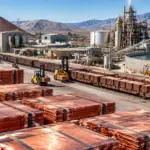
Caption: The Côté Gold ore processing facility, where real-time data from the 5G network optimizes throughput and mineral extraction.
What’s Next: Beyond the Open Pit
While Côté Gold is the current flagship for this technology, the implications for underground mining are even more profound.
Underground environments are notoriously difficult for communication. Rock is a very effective shield against radio waves. However, the lessons learned from the “5G Underground” initiatives at Côté Gold are already being studied for IAMGOLD’s other assets and the broader industry.
We are moving toward a world where a mine “breathes” data. From ventilation-on-demand (VoD) systems that only turn on when they detect equipment in a drift, to automated rock-bolters that can work through the shift change, the connectivity provided by Nokia and Ambra Solutions is the essential oxygen for these systems.

Caption: A remote operations center where specialists monitor autonomous equipment across multiple sites, a key feature of the “Mine of the Future” model.
The Bottom Line
Côté Gold is a signal. It tells the rest of the industry that the transition to the autonomous era is no longer “ten years away.” It is happening now, in the Canadian Shield.
IAMGOLD’s decision to rewire their flagship asset for 5G isn’t just about technical superiority. It’s a strategic pivot toward a safer, more predictable, and more profitable way of extracting value from the ground. In an era where “ESG” and “Efficiency” are the dual mandates of every major mining house, the 5G-enabled autonomous mine isn’t just a vision: it’s the only way forward.
The trucks are moving. The data is flowing. The era of the digital mine has arrived.