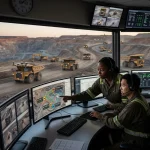
In the second quarter of 2026, the global mining industry has reached a technological inflection point. For decades, the industry operated under a "run-to-fail" or strictly scheduled maintenance paradigm. However, as of April 2026, the integration of Artificial Intelligence (AI) and Digital Twins has shifted the operational baseline. Predictive maintenance (PdM) is no longer a pilot project; it is the primary driver behind a documented 20% to 30% reduction in unplanned downtime across major Tier-1 assets.

This technical analysis explores the synergy between AI-driven diagnostics and physical mining infrastructure, drawing on recent data from Deloitte and Skillings Mining Review to quantify how these technologies are safeguarding millions in operational expenditure (OPEX).
The Architecture of Predictive Maintenance in 2026
Predictive maintenance in 2026 relies on a sophisticated "sensor-to-cloud" pipeline. Unlike traditional telemetry, which simply alerted operators when a threshold was crossed, modern AI systems utilize deep learning to recognize the "fingerprints" of impending failure weeks before they manifest physically.
The tech stack typically comprises three layers:
- The Edge Layer: High-frequency vibration sensors, acoustic emitters, and thermal imagers installed on critical path equipment such as SAG mills, crushers, and autonomous haulage fleets.
- The Digital Twin Layer: A virtual replica of the physical asset that runs real-time simulations. By comparing live data against the "ideal" performance model, the system can isolate anomalies that would be invisible to human monitoring.
- The Intelligence Layer: AI algorithms, often trained on decades of historical failure data, that provide a probability-weighted timeline for component exhaustion.
According to Deloitte’s 2026 Industry Outlook, the ability to synthesize these layers has allowed miners to move from reactive repairs to "prescriptive" interventions. Operators are no longer just told that a bearing will fail; they are told when it will fail and what specific parts must be staged at the site to minimize the repair window.
More Read



Quantifying the 20-30% Downtime Reduction
The financial impact of unplanned downtime in mining is staggering, often exceeding $100,000 per hour for large-scale copper or iron ore operations. By April 2026, the industry-wide adoption of AI has systematically eroded these losses.
Recent benchmarks indicate that predictive maintenance suites are delivering a 20-30% reduction in unplanned outages. This is achieved through three primary mechanisms:
More Read

1. Early Detection of Vibrational Anomalies
In one recent instance documented by Skillings Mining Review, an AI system at a major copper-gold project identified a 40-fold spike in vibration frequencies in a primary mill. While the mill appeared to be functioning normally to the site engineers, the AI flagged a rapid deterioration in the internal assembly. By scheduling a 12-hour intervention three weeks in advance, the operator avoided a catastrophic mid-December failure that would have shuttered the facility for twenty days.
2. Digital Twin Synchronization
Digital twins allow for "what-if" modeling. If a haul truck shows signs of elevated engine temperature, the digital twin simulates whether the vehicle can finish its shift or if it requires immediate removal from the circuit. This level of granular decision-making prevents the "over-maintenance" of healthy equipment, which historically accounted for up to 15% of unnecessary maintenance costs.
3. Visual Data and Upstream Diagnostics
AI is now capable of processing real-time visual feeds from crushers and conveyors to detect blockages or liner wear. By identifying upstream issues: such as oversized material entering a secondary crusher: the system can adjust feed rates or trigger a liner replacement before the equipment reaches a breaking point. This integration is critical for maintaining the 2026 critical minerals scoreboard where supply chain consistency is paramount.

Case Study: High-Altitude Operational Resilience
The application of AI-driven maintenance is perhaps most visible in frontier environments, such as the Andean copper belt. At high-altitude sites, where logistics for replacement parts can take weeks, the cost of unplanned downtime is amplified by geographic isolation.
Operators in these regions are using AI to manage the "health" of Ground Engaging Tools (GET). By monitoring the stress loads on excavator buckets and drill strings, AI systems can predict the exact moment a tooth or bit will fail.

For companies involved in the Africa-emerges-as-strategic-anchor-for-2026 movement, these AI tools are essential for de-risking investments in the Lobito Corridor and other emerging infrastructure hubs. When the nearest specialized repair shop is 500 miles away, predictive accuracy becomes a survival metric.
The Role of AI in Commodity Price Stability
The "AI-Mining Synergy" has broader implications for global markets. In 2026, the volatility of commodities like lithium and gold is increasingly tied to the operational uptime of major producers.
When a Tier-1 mine goes offline unexpectedly, it creates a supply shock. For example, in the current lithium forecast 2026, supply growth is tightly forecasted. Any significant unplanned downtime in the Lithium Triangle or Western Australia could send prices into a tailspin. AI acts as a "buffer" against these shocks by ensuring that production targets are met with surgical precision.
Similarly, in the gold sector, where technical liquidity traps are a constant concern for investors, AI-driven productivity ensures that high-cost underground operations remain viable. For a deeper look at these market drivers, see our gold price forecast 2026.
Challenges to Implementation: The Data Gap
Despite the clear benefits, the transition to an AI-centric maintenance model is not without friction. A significant hurdle remains the "data gap." Forrester research indicates that between 60% and 73% of data generated within mining organizations goes unused for strategic purposes.
Technical challenges include:
- Legacy Systems: Many older mines operate with analog equipment that lacks the sensor density required for AI training.
- Interoperability: Getting different OEM (Original Equipment Manufacturer) systems to communicate within a single Digital Twin environment remains a hurdle.
- Talent Scarcity: There is a growing demand for "Maintenance Data Scientists": professionals who understand both the mechanics of a hydraulic pump and the nuances of a neural network.

2026 Outlook: Prescriptive Autonomy
As we look toward the remainder of 2026 and into 2027, the trend is moving from predictive to prescriptive autonomy. We are entering an era where the AI doesn't just alert a technician; it automatically re-routes an autonomous haul truck to the service bay and pre-orders the necessary components via a connected supply chain API.
For the investor and the operator, the takeaway is clear: the integration of AI is no longer a luxury for the "mine of the future." It is a fundamental requirement for the mine of the present. Those who fail to achieve a 20-30% reduction in downtime through these technologies will find themselves on the wrong side of the cost curve in an increasingly competitive global market.
The synergy between AI and mining is saving millions today, but its greater value lies in the long-term stabilization of the global minerals supply chain. Whether it is addressing the antimony supply crunch or optimizing the Energy Fuels White Mesa breakthrough, predictive maintenance is the silent engine of the modern extraction industry.
Data Snapshot: PdM Impact 2026
| Metric | Industry Average (Pre-AI) | 2026 Industry Benchmark (AI-Enabled) | % Change |
|---|---|---|---|
| Unplanned Downtime (Hours/Year) | 1,200 | 840 | -30% |
| Maintenance Costs (% of OPEX) | 35% | 24% | -31.4% |
| Asset Life Extension (Years) | 10 | 13 | +30% |
| Sensor Data Utilization | 15% | 85% | +466% |
Source: Skillings Mining Intelligence / Deloitte 2026 Global Mining Report.