2026 Lithium Power Map : Early Access Open ($59) | Get the latest sector data and secure your copy here: https://skillings.short.gy/LithiumPreSale


By Rachel Adams
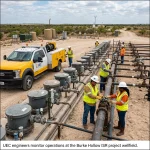
BEEVILLE, Texas : Uranium Energy Corp (NYSE American: UEC) has officially commenced uranium production at its Burke Hollow In-Situ Recovery (ISR) project in South Texas. The milestone marks the first time a new ISR mine has been commissioned in the United States in over a decade, signaling a significant shift toward domestic resource independence as the nation grapples with a tightening global nuclear fuel supply chain.
The startup of Burke Hollow is the culmination of a 14-year journey that began with a grassroots discovery by UEC in 2012. Located within the prolific South Texas Uranium Belt, the project is a cornerstone of UEC’s “hub-and-spoke” production strategy, where uranium-loaded resins from satellite mines like Burke Hollow are transported to a central facility for final processing into yellowcake (U3O8).
More Read

“This is a transformative moment for the U.S. uranium industry,” said Charles Pitts, CEO of SMR OPS 100K. “We are seeing the fruition of years of strategic land acquisition and permitting. Burke Hollow isn’t just another mine; it is the physical manifestation of the U.S. re-asserting itself in the nuclear fuel cycle at a time when energy security has moved to the forefront of national policy.”

A Strategic Asset in a Changing Geopolitical Landscape
The commencement of production at Burke Hollow arrives as the U.S. nuclear industry faces unprecedented pressure to decouple from Russian uranium supplies. Following the legislative push to ban Russian uranium imports by 2028, domestic producers have been racing to fill a projected supply gap that threatens the stability of the American reactor fleet.
Burke Hollow sits on a 20,000-acre site, of which only about half has been explored to date. Despite this, the project already boasts a substantial resource base. According to the company’s latest technical reports, the site contains 6,155,000 pounds of U3O8 in measured and indicated resources, with an additional 4,883,000 pounds in the inferred category.
More Read

This discovery is widely cited as the largest ISR uranium find in the United States in the last ten years. Its activation allows UEC to leverage its Hobson Central Processing Plant, which is licensed to produce up to 4 million pounds of uranium annually. The Hobson plant serves as the “hub,” while Burke Hollow acts as the primary “spoke” in the Texas operations.
The Hub-and-Spoke Advantage
The ISR method used at Burke Hollow is considered the most environmentally friendly and cost-effective way to extract uranium. Unlike conventional open-pit or underground mining, ISR involves circulating oxygenated groundwater through the ore body to dissolve the uranium. The solution is then pumped to the surface, where the uranium is extracted using ion-exchange resins.
By utilizing the hub-and-spoke model, UEC significantly reduces the capital expenditure (CAPEX) required to bring new resources online. The company does not need to build a full processing mill at every site. Instead, the resin-loading occurs at the satellite mine, and the final “drying” and packaging take place at the Hobson facility.

This operational efficiency is a key component of the Mining M&A 2026: Critical Minerals and ESG Deal Outlook, as companies seek to maximize the value of existing infrastructure in a high-interest-rate environment.
Expanding the Production Profile
With Burke Hollow now online, UEC has become the only uranium company in the United States currently operating two active ISR hub-and-spoke platforms. The company’s Wyoming operations, centered around the Christensen Ranch ISR mine and the Irigaray Central Processing Plant, recently restarted production earlier this year.
Between the Texas and Wyoming hubs, UEC controls a licensed production capacity of approximately 12 million pounds of U3O8 per year. To put this in perspective, the entire U.S. domestic production in recent years has often struggled to exceed 100,000 pounds annually, leaving the country almost entirely dependent on imports from Kazakhstan, Canada, and Russia.
UEC Domestic Production Capacity Overview
| Project | Location | Status | Licensed Capacity (lbs/yr) |
|---|---|---|---|
| Hobson/Burke Hollow | Texas | Active | 4,000,000 |
| Irigaray/Christensen Ranch | Wyoming | Active | 2,500,000 |
| Ludeman Project | Wyoming | Permitting/Dev | Planned 2,000,000+ |
| Reno Creek | Wyoming | Permitted | 2,000,000 |
| Total Licensed | ~12,500,000 |
The company has indicated that the next phase of its growth will involve the Ludeman ISR project in Wyoming, which is slated for a 2027 startup. This aggressive timeline reflects a broader industry trend where the “Road to 100K” mandate: achieving significant domestic output: is driving rapid operational deployments.
Environmental Stewardship and Community Impact
The approval for Burke Hollow from the Texas Commission on Environmental Quality (TCEQ) followed years of rigorous environmental assessments. Because ISR mining does not require moving massive amounts of earth or creating tailings piles, the surface footprint is minimal. Land can often be returned to agricultural use, such as grazing, while the mine is still in operation.
As the industry moves toward more sustainable practices, the role of domestic supply chains becomes even more critical. Insights from The Rare Earth Supply Chain: What It Is and Why It Matters suggest that the “localization” of mineral production is essential not just for security, but for meeting modern ESG (Environmental, Social, and Governance) standards that demand transparency in how materials are sourced.
Market Drivers and Small Modular Reactors (SMRs)
The demand for uranium is being further bolstered by the emergence of Small Modular Reactors (SMRs). These smaller, more flexible nuclear plants are designed to be built in factories and shipped to sites, potentially lowering the barrier to entry for nuclear power.
As SMR technology advances, the need for a reliable, Western-sourced fuel supply becomes non-negotiable. The volatility seen in other energy sectors, such as the Copper Price Forecast 2026, highlights the risks of relying on concentrated global supply chains. Uranium producers are positioning themselves to be the bedrock of this new energy paradigm.
Operational Risks and Outlook
While the startup of Burke Hollow is a landmark achievement, the project is not without risks. Like all ISR operations, success depends on maintaining the precise chemistry of the lixiviant (the extraction fluid) and managing the “flare” or movement of groundwater. Furthermore, the uranium spot price, while currently sitting at multi-year highs, remains sensitive to geopolitical shifts and the pace of global reactor restarts.
However, UEC’s unhedged position allows it to benefit directly from price increases. By not locking in long-term contracts at lower prices, the company is betting that the structural deficit in the uranium market will continue to drive valuations upward.
As we look toward the remainder of 2026, the focus for UEC will be on optimizing the flow rates at Burke Hollow and scaling up the resin shipments to Hobson. If successful, this project will serve as the blueprint for how the U.S. can rebuild its critical mineral capacity from the ground up.