2026 Lithium Power Map : Early Access Open ($59) | Get the latest sector data and secure your copy here: https://skillings.short.gy/LithiumPreSale


By Sonny Miller
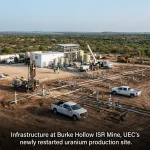
Uranium Energy Corp (UEC) commencing production at Burke Hollow is one of the more consequential domestic uranium developments in years: not because it’s flashy, but because it’s operational. In practical terms, it adds a new U.S. ISR mining source in South Texas, connects into existing processing infrastructure, and reinforces a “mine-to-plant” pathway that the U.S. uranium sector has struggled to scale for more than a decade.
What makes Burke Hollow stand out is the combination of: (1) a rare greenfield-to-production execution in the U.S. regulatory environment, (2) proximity to an existing processing hub (UEC’s Hobson plant, licensed for 4 million lbs/year), and (3) timing: coming as U.S. utilities, policymakers, and fuel buyers look for domestic uranium supply resilience.
More Read



Why Burke Hollow matters: the “first new ISR mine in a decade” signal
ISR mining has long been the U.S. uranium industry’s most scalable pathway because it typically avoids the footprint of conventional open pit or underground uranium mining. But in the last decade, the U.S. saw limited new-start mine development; production was constrained by low prices, financing friction, and a fuel cycle that leaned heavily on imports.
Burke Hollow’s start is important for one clear reason: it is new U.S. ISR production coming online after a long lull. For investors and operators, that matters less as a headline and more as a proof point that:
More Read

- Permitting, wellfield buildout, and production ramp can still be executed in the U.S.
- ISR “hub-and-spoke” models remain viable when they connect to existing plants.
- Domestic supply growth can happen incrementally: without requiring brand-new mills.
In a market where the U.S. wants more nuclear generation and also wants to reduce dependence on foreign uranium and services, “new production” is not just a commodity story: it is a supply-chain capacity story.
The South Texas advantage: uranium geology plus logistics
Burke Hollow’s South Texas location is not incidental. South Texas ISR uranium is a known district with established operational history, technical expertise, and service ecosystems (drilling, wellfield installation, water handling, and related environmental monitoring). That tends to shorten the learning curve compared to first-of-kind districts.
From a logistics and operating cost perspective, South Texas also supports a simpler “ore-to-plant” chain because the region is already built around ISR-style transport and processing flows. The key operational edge is minimizing the distance: and complexity: between wellfields and processing, which can translate into:
- faster cycles from wellfield production to processing,
- lower handling friction,
- tighter quality control on solutions and plant feed,
- more predictable ramp sequencing.
Burke Hollow’s strategic value increases because it’s not an isolated site: it is designed to feed the Hobson plant, reinforcing the economics of a centralized processing hub.
The Hobson plant: 4M lbs/year capacity changes the conversation
UEC’s Hobson Central Processing Plant is licensed for 4 million pounds of U₃O₈ per year capacity. In uranium, processing capacity is often the bottleneck: particularly when projects are forced to permit entirely new facilities. Feeding a pre-existing licensed plant can compress timelines and reduce capital intensity relative to greenfield processing.
What that means in real terms is that Burke Hollow is not simply “a mine.” It is a spoke that can plug into a hub with meaningful throughput capacity, potentially allowing UEC to:
- add additional ISR wellfields over time,
- shift feed sources as different patterns mature,
- optimize for recoveries and operating costs,
- scale production without rebuilding the entire processing chain.
This “hub-and-spoke” design is one of the strongest reasons Burke Hollow reads as a milestone. The asset’s value is partly its pounds in the ground: but equally its role in a broader system that can move pounds to market.

What ISR mining changes (and what it doesn’t)
ISR mining is often described as a lower-disturbance method, but for decision-makers the more useful framing is operational:
What ISR tends to improve
- Speed of development: wellfields can be built in phases rather than as a single, massive construction event.
- Modularity: production can be expanded by adding patterns, not necessarily by expanding pits or shafts.
- Capital profile: typically lower upfront capex than conventional mining and milling.
What ISR does not eliminate
- Hydrogeology risk: permeability, confinement, and fluid flow behavior ultimately govern recoveries and operating stability.
- Chemistry management: lixiviant control, resin performance, and precipitation systems still require tight process discipline.
- Regulatory requirements: groundwater protection, restoration, monitoring, and reporting remain core to ISR social license.
Burke Hollow is best viewed through this lens: it is a scalable ISR system tied to an existing plant, but it still lives or dies on wellfield performance, process execution, and compliance discipline.
A domestic uranium supply story: without pretending the U.S. can “flip a switch”
The U.S. uranium supply chain challenge is not solved by one new project. But Burke Hollow is meaningful because it expands domestic production capacity in a way that can be repeated.
The underlying supply reality is straightforward:
- The U.S. consumes far more uranium than it produces.
- Utility procurement is cautious and long-cycle; contracting decisions look years ahead.
- Domestic supply growth depends on permitting certainty, processing capacity, and reliable production: not just resources.
Burke Hollow contributes to the “rebuild” narrative because it is an operational asset feeding licensed processing. It may not move global uranium prices by itself, but it strengthens the U.S. portion of the supply curve: exactly where policymakers want incremental capacity.
Investor magnet logic: why milestones matter more than slide decks
In mining markets, investors tend to re-rate companies when they cross execution thresholds: first production, stable plant runs, consistent deliveries, expansion visibility. Burke Hollow hits that framework. It is a milestone that can reduce perceived execution risk, particularly if early operating data supports:
- stable flow rates and wellfield control,
- predictable recoveries,
- consistent plant feed quality,
- steady production cadence rather than one-off batches.
This is the difference between “optional pounds” and “operating pounds.” The former can be discounted heavily. The latter often earns a higher confidence multiple because it can support contracts, cash flow planning, and expansions.
Timeline watch: what to track in the next 2–4 quarters
With ISR operations, the early signal is rarely a single number. It’s a pattern of operational updates that show the system is under control. For Burke Hollow (and UEC’s broader South Texas network), the market will likely focus on the following checkpoints:
- Wellfield ramp sequencing
- How quickly new patterns are added and stabilized
- Whether production growth is linear or “lumpy”
- Processing performance at Hobson
- Resin loading efficiency and cycle times
- Precipitation and drying throughput stability
- Any bottlenecks that appear at higher feed rates
- Cost and restoration discipline
- Water handling and chemistry management costs
- Restoration provisioning clarity over time (critical for ISR credibility)
- Contracting posture
- Volumes committed vs. spot exposure
- Delivery schedules that match ramp reality
None of these require hype to be impactful. ISR projects can look ordinary on the surface while compounding into meaningful annual production.
Mini-dataset: why a 4M lbs/year hub is strategically leveraged
A practical way to understand the Burke Hollow + Hobson setup is to think in “capacity leverage” terms. The hub’s licensed throughput creates optionality: multiple spokes can contribute feed over time.
| Component | What it is | Why it matters for domestic uranium supply |
|---|---|---|
| Burke Hollow | New ISR production source in South Texas | Adds incremental domestic output with modular ramp potential |
| Hobson plant | Central processing hub (licensed ~4M lbs/yr) | Avoids greenfield processing build; supports multi-deposit feed strategy |
| Hub-and-spoke model | Multiple ISR projects feeding one plant | Enables phased growth and operational flexibility |
This is the core “investor magnet” feature: the assets function as a system, not a one-off project.
Key risks (and how they typically show up)
Even strong ISR assets can underperform if a few variables drift. For Burke Hollow, the key risk categories are familiar to experienced uranium operators:
1) Reservoir and flow risk
ISR depends on consistent permeability and confinement. If flow channels or heterogeneity reduce sweep efficiency, recovery can under-deliver versus models. This usually shows up as lower-than-expected uranium concentrations in production solutions or higher reagent consumption to maintain performance.
2) Ramp timing risk
ISR ramps are often phased, but permitting, drilling schedules, equipment availability, and commissioning realities can push timelines. Investors should watch for schedule changes and the reasons behind them (technical vs. supply chain vs. regulatory).
3) Processing bottleneck risk
Even with a licensed plant, higher feed rates can expose issues: resin capacity constraints, precipitation throughput limits, maintenance cycles, or QA/QC needs. These are solvable, but they can change near-term output.
4) Regulatory and restoration risk
ISR is regulated heavily because of groundwater considerations. Any compliance deviation can slow operations and raise costs. Restoration liabilities can also become a valuation issue if provisions are unclear or appear to escalate unexpectedly.
5) Market structure risk (contracting vs. spot)
Uranium pricing and contracting cycles can reward uncontracted exposure during up-cycles: but they can punish it if prices soften or if utilities delay procurement. The “right” posture depends on production certainty and balance sheet resilience.
Why this fits the U.S. policy backdrop (without leaning on politics)
The U.S. nuclear conversation increasingly centers on reliability, decarbonization, and energy security. Uranium mining sits at the start of that chain. Burke Hollow’s relevance is that it contributes tangible domestic output: something policymakers can point to when discussing fuel supply resilience.
For operators and investors, the key point is not political messaging; it is that policy attention can influence:
- utility contracting sentiment toward U.S./allied supply,
- financing availability for domestic projects,
- the broader willingness to support fuel cycle capacity (conversion, enrichment, etc.).
Burke Hollow doesn’t need a policy tailwind to work, but policy focus can reduce long-term demand uncertainty for domestic pounds.