Penny (Monday, February 2, 2026)

Canadian mining company Rio2 achieved first gold production at its Fenix mine in Chile on January 23, pouring approximately 897 ounces of gold and officially marking the transition from construction to full-scale operations. The milestone establishes Fenix as Chile’s newest producing gold mine and caps a 14-month construction sprint that delivered the $235 million project on time and on budget.
The inaugural pour follows an additional 358 ounces produced during December plant commissioning activities, bringing total early-stage production to roughly 1,255 ounces of gold along with approximately 131 ounces of silver. Rio2 now shifts focus to ramping operations toward a throughput rate of 20,000 tonnes of ore per day while targeting 60,000 to 70,000 ounces of gold production in 2026.
“This is the culmination of an eight-year journey,” Rio2 Executive Chair Alex Black stated in company materials, referencing the period since Rio2’s 2018 merger with Atacama Pacific Gold Corporation. The on-schedule delivery positions Rio2 as one of the few junior miners to successfully transition a development project into production during a period marked by widespread cost overruns and construction delays across the sector.

More Read

Run-of-Mine Design Cuts Environmental Footprint
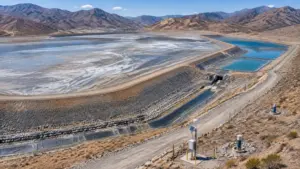
Fenix operates as a run-of-mine heap leach facility along Chile’s Maricunga gold belt in the Atacama region, a design choice that eliminates the need for crushing infrastructure or conventional tailings storage facilities. Ore extracted from the open pit moves directly to the leach pad, where cyanide solution percolates through the material to dissolve gold and silver before flowing to processing facilities for metal recovery.

This operational approach reduces both capital expenditures and environmental impact compared to conventional milling operations. The absence of tailings dams: which have become lightning rods for regulatory scrutiny and community opposition across South America: positions Fenix as a lower-risk asset from a permitting and liability standpoint.
The heap leach configuration also allows for relatively rapid production ramp-up, as the company can begin stacking ore and initiating the leaching process without waiting for complex processing circuits to reach optimal performance. Rio2 indicated the facility is now advancing toward its nameplate capacity of 20,000 tonnes per day as mining operations scale.
More Read

Employment and Regional Impact
Construction activities generated approximately 1,200 jobs during the build phase, with the operation expected to support roughly 550 permanent positions over Fenix’s projected 17-year mine life. The employment figures represent significant economic activity for the Atacama region, where mining historically serves as the dominant industrial sector.

The 14-month construction timeline stands in contrast to several high-profile projects elsewhere that have experienced years-long delays and budget overruns exceeding 50 percent of original estimates. Rio2’s ability to deliver Fenix on schedule stems partly from the relatively straightforward heap leach design and partly from pre-existing infrastructure in the Maricunga belt, where multiple gold operations have cycled through production over the past three decades.
Chile’s regulatory environment for mining projects remains among the most stable in Latin America despite periodic political tensions around resource nationalism and environmental standards. The country produces roughly 5 percent of global gold output while dominating copper production at approximately 25 percent of world supply.
Production Trajectory and Phase 2 Expansion
Rio2’s 2026 production target of 60,000 to 70,000 ounces positions Fenix as a mid-tier gold operation by Chilean standards, though the company has indicated plans for a Phase 2 expansion that would drive future growth. Details on the expansion timeline and production uplift remain pending, but management stated updates will be provided as engineering and economic studies advance.

The production profile at Fenix benefits from the nature of heap leach operations, which typically see metal recovery extend over months or even years as solution continues percolating through stacked ore. This creates a more predictable cash flow profile compared to conventional milling operations, where production responds immediately to plant throughput and metallurgical performance.
Gold prices averaging around $2,650 per ounce in recent weeks provide a favorable economic backdrop for the production ramp-up. At that price level and assuming all-in sustaining costs in the $1,100 to $1,300 per ounce range typical for heap leach operations, Fenix should generate operating margins exceeding 50 percent during its initial years of operation.
The silver byproduct: though relatively minor at current production rates: provides additional revenue that helps offset operating costs. Silver prices hovering near $30 per ounce add modest but meaningful cash flow to the operation’s economics.
Maricunga Belt Context
The Maricunga gold belt has hosted multiple mining operations over the past four decades, with varying degrees of success. High altitude, extreme aridity, and remoteness create operational challenges, but the region’s geology continues attracting exploration and development capital due to proven gold endowment.
Several operators have cycled through production at different deposits along the belt, with outcomes ranging from highly profitable operations to projects that struggled with metallurgy, water availability, or permitting challenges. Rio2’s successful commissioning at Fenix adds to the positive track record, though the true test will come as the operation demonstrates sustained performance at nameplate capacity.
Water supply represents a critical constraint for mining operations in the Atacama, the driest non-polar desert on Earth. Heap leach operations typically require less water than conventional milling facilities, but sustained production still demands reliable water sources and robust recycling infrastructure. Rio2 has not disclosed detailed water supply arrangements, though company materials indicate necessary permits and infrastructure are in place.

The Atacama’s elevation: Fenix sits at roughly 4,000 meters above sea level: complicates both construction and operations due to altitude-related health and safety considerations. Workers require acclimatization periods, and equipment performance can be affected by reduced oxygen levels. These factors contributed to construction and operating costs but did not prevent Rio2 from achieving its schedule and budget targets.
Junior Mining Sector Performance
Fenix’s successful commissioning provides a rare positive case study in a junior mining sector that has seen numerous high-profile failures and delays in recent years. Multiple development projects have blown through budgets, missed timelines, or encountered fatal technical or permitting obstacles that forced abandonment or sale to larger operators.
The ability to deliver a project on time and on budget immediately enhances Rio2’s credibility with investors and potential financing partners for future growth initiatives. Junior miners live or die based on execution track records, and Fenix positions Rio2 favorably for accessing capital markets or partnership opportunities as Phase 2 planning advances.
First gold production typically triggers significant operational focus on process optimization, equipment reliability, and workforce productivity as mining and processing teams work through the inevitable issues that emerge during ramp-up. Rio2’s relatively smooth commissioning period: evidenced by December’s 358-ounce pre-commercial production: suggests major systems are performing as designed, though sustained performance over coming months will provide the definitive verdict.
The transition from construction to operations also shifts Rio2’s financial profile from cash-consuming development company to cash-generating producer. This transformation typically supports share price appreciation and improved access to debt or equity financing for growth projects, assuming production volumes and costs track guidance.
Chile’s position as a tier-one mining jurisdiction with established regulatory frameworks, reliable infrastructure, and political stability provides operational advantages compared to greenfield projects in frontier regions. Rio2’s success at Fenix may encourage other junior miners to evaluate opportunities along the Maricunga belt or elsewhere in Chile’s established mining districts.