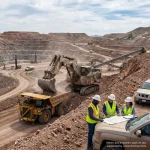
Heavy machinery operates at the Copper One site in southeastern Utah, the world’s first autonomy-first copper mine and refinery.


By Charles Pitts
LA SAL, UTAH – Mariana Minerals has officially resumed mining operations at its Copper One facility in southeastern Utah, marking a pivotal shift in how the global mining industry approaches commodity extraction. The announcement, made on April 27, 2026, confirms the restart of a project that was mothballed in late 2024 but has now returned as the world’s first “autonomy-first” mine and refinery.
The transition from a traditional, labor-heavy operation to a fully autonomous ecosystem follows Mariana Minerals’ acquisition of the Lisbon Valley Mining Company in late 2025. By integrating advanced robotics, private 5G networks, and a unified operating system known as MarianaOS, the company aims to solve the persistent cost and labor challenges that forced the previous owners to cease production.
For the broader industry, the Copper One restart is a high-stakes test case for the “AI-copper nexus,” where digital intelligence is leveraged to meet the surging global demand for electrification.
More Read

The Path to Autonomy: Why the Restart Matters
The Copper One site has been a fixture of the Utah mining landscape for over 15 years, producing high-purity copper cathode since 2009. However, the operation was historically plagued by rising costs and the logistical difficulty of maintaining a human workforce in the remote San Juan County region. When Mariana Minerals took over in Q4 2025, the strategy pivoted away from traditional management toward a software-driven operational model.

“This isn’t just a mine with some robots added to it,” the company stated during the restart briefing. “It is an autonomous system that happens to mine copper.”
The significance of this restart cannot be overstated in the context of the current copper deficit forecast for 2026. With global supply chains struggling to keep pace with the energy transition and data center expansion, the ability to bring “stranded” assets like Copper One back online through technology is a major development for the sector.
More Read

MarianaOS: The Digital Backbone of Copper One
At the heart of the operation is MarianaOS, a proprietary unified operating system that coordinates three distinct subsystems: MineOS, PlantOS, and CapitalProjectOS. Unlike traditional mining software, which often operates in silos, MarianaOS treats the entire value chain: from the initial blast to the final refined cathode: as a single, interconnected data stream.
MineOS and Autonomous Haulage
On April 9, 2026, the company successfully deployed its first fleet of autonomous haulage trucks integrated with Pronto’s autonomy system. These trucks operate without human intervention, navigating the complex terrain of the open pit through a combination of LiDAR, radar, and GPS. MineOS manages the dispatching and route coordination in real-time, optimizing for fuel efficiency and ore throughput.
Autonomous haulage trucks navigate the dusty terrain of the Utah mine without human drivers, coordinated by the MineOS software.

PlantOS and the Refinery Loop
The autonomy does not stop at the pit’s edge. PlantOS oversees the complex chemical processes involved in copper recovery. Copper One utilizes heap bioleaching, solvent extraction, and electrowinning (SX-EW) to produce its final product. By using autonomous sensors to monitor acid concentration and flow rates, Mariana Minerals has reported a 30% reduction in refining costs. The system can adjust the refining process in seconds, a task that previously required manual sampling and lab analysis.
CapitalProjectOS
Perhaps the most unique aspect of the operation is CapitalProjectOS. This system manages the expansion of the mine’s physical infrastructure. As Mariana Minerals scales toward its target of 50,000 metric tons per year, the software coordinates the construction of new heap leach pads and refinery upgrades in parallel with active production, minimizing downtime and capital waste.
The Economic Case: Cutting Costs and Scaling Production
The financial implications of the Copper One restart are significant for Mariana Minerals and its investors. By removing the dependencies of traditional labor-intensive mining, the company has projected a 50% reduction in mining costs.
In an industry where margins are often thin and sensitive to commodity price fluctuations, these savings provide a massive buffer. Currently, the operation employs approximately 80 people, but Mariana plans to expand the workforce to over 300 as production ramps up.
Why More Tech Means More Jobs
There is a common narrative that automation kills jobs, but Mariana Minerals leadership argues the opposite. CEO Turner Caldwell has noted that technology makes marginal deposits economically viable. “When you pull more technology forward into this space, you are net increasing the number of jobs because the operation is actually operating,” Caldwell stated. Without the autonomous systems, the mine would likely have remained closed, providing zero jobs to the local economy.
For San Juan County: one of Utah’s most economically challenged areas: the restart represents a vital infusion of capital and high-tech employment opportunities.
A Boston Dynamics Spot robot performs safety inspections and environmental monitoring in the copper processing facility.

Strategic Partnerships: 5G and Robotics
The success of the Copper One restart relies on a specialized technology stack provided by industry leaders:
- Celona (Private 5G): The entire 10,000-acre site is covered by a private 5G network. This low-latency connectivity is essential for the real-time data transmission required by autonomous vehicles and the thousands of sensors scattered across the refinery.
- Pronto (AI Haulage): The integration of Pronto’s AI allows for high-speed, safe haulage in conditions that might be challenging for human operators, such as heavy dust or night shifts.
- Boston Dynamics (Site Safety): Announced on April 21, 2026, the deployment of “Spot” robots provides a layer of safety monitoring. These quadrupeds traverse hazardous areas of the refinery and pit to check for leaks, structural issues, or environmental hazards, removing humans from high-risk zones.
Copper Production and the 2030 Roadmap
Mariana Minerals has set an ambitious target of reaching 50,000 metric tons of refined copper annually by 2030. This scale would place Copper One among the more significant producers in the United States.
The restart is the second major project for the company, following its “Lithium One” extraction facility in East Texas. The two projects together signal Mariana’s intent to become a dominant player in the critical minerals space, specifically targeting the materials needed for the hyperscale data center boom.
The heap leaching pads at Copper One use autonomous irrigation systems to maximize mineral recovery from the ore.

Outlook for the Mining Industry
The resumption of operations at Copper One serves as a blueprint for the future of the industry. As ESG (Environmental, Social, and Governance) requirements become stricter and labor shortages persist, the “autonomy-first” model offers a path forward.
By reducing the physical footprint of human staff and optimizing chemical usage through PlantOS, Mariana Minerals is positioning Copper One as a leader in sustainable mining. The ability to monitor environmental impact in real-time through the MarianaOS dashboard allows for a level of transparency that was previously impossible.
For operators and investors, the lesson of Copper One is clear: the most valuable asset in a 2026 mine may not be the ore in the ground, but the software used to get it out.
High-purity copper cathodes are the final product of the autonomous refinery, ready for shipment to global markets.

As operations continue to scale in Utah, Skillings Mining Intelligence will monitor the production data and any potential hurdles in the autonomous rollout. If Mariana Minerals meets its 50,000-ton target, it could trigger a wave of similar autonomous conversions across North American mining sites.
Quick Facts: Mariana Minerals Copper One Restart
- Location: San Juan County, Utah.
- Target Output: 50,000 metric tons per year by 2030.
- Key Tech: MarianaOS (MineOS, PlantOS, CapitalProjectOS).
- Primary Partners: Pronto, Boston Dynamics, Celona.
- Economic Impact: 50% reduction in mining costs; 30% reduction in refining costs.
- Workforce: Scaling from 80 to 300+ employees.