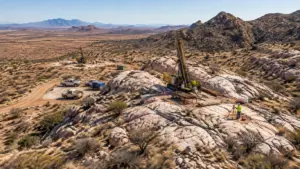
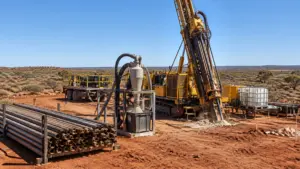
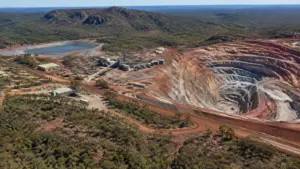
Copper processing and logistics infrastructure reflect the supply-chain pressures shaping the market.

By Skillings Mining Intelligence Desk
Copper is trading close to record levels as Chinese manufacturers rebuild inventories ahead of public holidays, while governments and mining companies move to secure longer-term supplies of critical minerals.
The United States is preparing to support up to $7 billion of mineral and energy projects in Argentina. In Australia, AIC Mines has agreed to acquire Materra Metals for $120 million, adding the Mt Cuthbert copper project to its Queensland portfolio. Elsewhere, First Quantum Minerals’ ownership restrictions on Jiangxi Copper remain a live example of how Canadian policy is shaping foreign participation in strategic mining assets.
In the United States, Korea Zinc’s proposed $7.4 billion Project Crucible in Tennessee is advancing with federal backing and environmental clearance.
Market snapshot
Latest quoted levels available in the referenced market feeds. Prices and benchmarks use different units and reporting conventions.

| Market | Latest quoted level | One-session move | What it signals |
|---|---|---|---|
| Copper, LME three-month | $14,664.50/t | +$102.50, +0.70% | Prices remain near record territory as spot availability tightens |
| Nickel, Shanghai spot | $18,795.82/t | +$44.05, about +0.23% | Modest recovery amid a well-supplied market |
| Lithium carbonate, industrial grade | $19,496.10/t | +$22.25, about +0.11% | Broadly stable pricing |
| Gold | $4,354.15/oz | +$11.13, +0.26% | Precious metals remain supported |
| Silver | $67.04/oz | +$1.032, +1.56% | Silver outperformed gold in the latest session |
Copper’s LME settlement was reported by Shanghai Metals Market. The nickel and lithium figures are from SMM’s metals pricing dashboard, while the gold and silver levels reflect the latest quoted precious-metals data summarized through Kitco.
U.S. prepares Argentina minerals and energy finance package
The U.S. Export-Import Bank is preparing to finance up to $7 billion of critical-minerals and energy projects in Argentina, according to reporting cited by Reuters.

The proposed financing is part of a broader U.S.-Argentina effort to establish more resilient supply chains for minerals including lithium, copper and rare earths. The framework is expected to combine loans, guarantees, grants and private-sector capital, while encouraging the use of U.S. equipment and services.
The two governments have also committed to identifying priority projects and supporting financing, permitting and offtake arrangements. The U.S. Embassy in Argentina said the framework is intended to accelerate secure and diversified mineral supply chains and create conditions for benchmark pricing and more transparent markets.
The financial scale is material for Argentina. Mining exports through the first part of the year were reported at approximately $5.36 billion, meaning a potential $7 billion financing envelope could have a significant effect on project development if funds are committed at scale.
The package does not create immediate mineral supply. Most projects would still require exploration, feasibility work, permitting, construction and commissioning. Its near-term importance is therefore financial rather than operational: government-backed capital could reduce political and financing risk for projects that meet U.S. supply-chain priorities.
Argentina’s lithium sector is the most obvious beneficiary, but the policy also places copper and other critical minerals within a wider U.S. strategy to reduce dependence on concentrated overseas processing capacity.
AIC Mines agrees to $120 million Materra Metals acquisition
AIC Mines has entered binding agreements to acquire 100% of Materra Metals for $120 million, adding the Mt Cuthbert Copper Project in northwest Queensland to its existing North Queensland operations.
The transaction comprises $20 million in cash and $100 million in AIC Mines shares, with 125.8 million shares to be issued at $0.795 each. AIC Mines has also agreed to a $70 million placement to cornerstone shareholder Hawke’s Point Resource Finance and its affiliates.
According to Mining.com.au, the placement will fund the cash component, transaction costs and an accelerated two-year exploration and development program.
Mt Cuthbert is located about 130 kilometers northwest of Cloncurry and 150 kilometers from AIC’s Eloise copper mine. The project covers approximately 2,400 square kilometers and includes 21 granted mining leases.
Its mineral resource estimate stands at 18.7 million tonnes grading 1.3% copper, containing approximately 246,000 tonnes of copper across five deposits. Sulphide material represents about 73% of the resource. Existing infrastructure includes an 8,000-tonne-per-year solvent extraction and electrowinning plant on care and maintenance, along with a camp, workshops and site offices.

Exploration and development work will determine the next stage of Mt Cuthbert’s copper potential.
AIC Mines said it plans to focus on the project’s sulphide potential and is considering a standalone copper sulphide processing facility. Planned work includes 60,000 meters of resource-definition drilling, at least 9,000 meters of regional exploration drilling and environmental baseline studies.
The deal remains subject to shareholder approval at an extraordinary general meeting. Completion is expected after the meeting, subject to the required conditions.
The transaction is notable for its scrip-heavy structure. It preserves cash for exploration and development while giving Materra shareholders exposure to the combined company. The key execution questions are resource conversion, metallurgical performance, permitting and the capital required to bring the project into production.
Shareable summary
- LinkedIn: AIC Mines is acquiring Materra Metals for $120 million, adding the Mt Cuthbert copper project in Queensland. The deal includes a $70 million placement and plans for 69,000 meters of exploration and resource drilling.
- X: AIC Mines agrees to buy Materra Metals for $120M, adding Mt Cuthbert’s 246,000 tonnes of contained copper to its Queensland portfolio. Shareholder approval is still required.
Copper nears records as Chinese inventories fall
Copper prices remain elevated as Chinese downstream buyers rebuild stocks before the Mid-Autumn Festival and National Day holidays.
LME copper reached an overnight high of approximately $14,774 per tonne before settling at $14,664.50 per tonne, according to SMM. Shanghai copper also moved higher, with the most-traded contract closing at 110,709 yuan per tonne.
The immediate driver is not simply futures momentum. Physical availability in China has tightened, with Shanghai social inventories reported at 43,900 tonnes, down 14,700 tonnes from the previous measurement. SMM also reported that copper inventories across major Chinese regions had fallen to 74,800 tonnes, significantly below the level recorded during the same period a year earlier.
Spot premiums have risen as consumers compete for available cathode. Shanghai premiums were quoted at 750–900 yuan per tonne against the relevant SHFE contract, while the average premium increased to 825 yuan per tonne.
Chinese copper ore and concentrate imports totaled approximately 2.51 million tonnes in August, according to customs data cited by SMM. That was higher than July but down 9.5% year over year, underscoring the difference between refined-metal demand and the availability of mined feedstock.

Low warehouse stocks and pre-holiday purchasing are supporting near-term copper premiums.
The market is also watching treatment and refining conditions, mine supply disruptions and the ability of smelters to secure concentrate. Pre-holiday restocking can support prices in the short term, but demand may moderate after the holiday period. For operators and buyers, the more important signal is whether tight spot availability persists after seasonal purchasing ends.
Skillings’ copper coverage and analysis of critical-minerals supply chains track the longer-term effect of mine investment, processing capacity and industrial demand.
First Quantum’s Jiangxi Copper cap remains a policy marker
First Quantum Minerals’ shareholder rights agreement with Jiangxi Copper continues to limit the Chinese company’s ability to increase its stake in the Canadian copper producer.
The agreement, announced in 2024, includes standstill provisions that restrict Jiangxi Copper from acquiring additional First Quantum shares without the company’s consent. The arrangement is scheduled to run until July 23, 2027, or until Jiangxi’s ownership falls below 10%, subject to the agreement’s terms.
Jiangxi also faces restrictions on selling a block of 5% or more and cannot transfer shares to a buyer that would own more than 9.9% of First Quantum after the transaction, subject to specified exceptions. The agreement grants Jiangxi the right to nominate one person for consideration for First Quantum’s board.
The provisions are set out in the shareholder rights agreement announcement.
The arrangement has broader relevance because it illustrates how strategic-minerals policy increasingly affects ownership structures. First Quantum is a major copper producer, while Jiangxi Copper is a large Chinese state-owned company. Canada has taken a cautious approach to foreign state-owned investment in critical-minerals companies.
The agreement does not eliminate commercial cooperation. It does, however, separate cooperation across the copper value chain from the question of control. That distinction is becoming more important as governments scrutinize ownership, board influence, offtake rights and access to processing assets.
Korea Zinc advances Tennessee’s Project Crucible
Korea Zinc’s Project Crucible is advancing as a proposed integrated smelter and critical-minerals processing complex in Clarksville, Tennessee.
The project has a planned investment of approximately $7.4 billion, including about $6.6 billion in capital expenditures, working capital and financing costs. Korea Zinc’s project announcement says the facility is expected to process roughly 1.1 million tonnes of raw material annually and produce about 540,000 tonnes of finished products.
The planned output includes zinc, lead and copper, along with antimony, indium, bismuth, tellurium, gallium and germanium. The facility is also expected to produce sulfuric acid and semiconductor-grade sulfuric acid.

Project Crucible is designed to combine base-metal production with critical-minerals refining.
The U.S. Department of Commerce has committed up to $210 million under the CHIPS and Science Act for equipment and related purposes. The project also includes a proposed U.S.-backed financing and investment structure, including approximately $2.15 billion arranged with investors and federal support.
Korea Zinc has said site preparation and foundation work are targeted to begin during the current construction phase, with phased commercial operations expected from 2029. Recent reporting indicates the project has cleared a key environmental review, allowing further permitting and project execution to proceed.
Project Crucible reflects a shift in U.S. minerals policy from import diversification toward domestic processing capacity. Its significance lies not only in the volume of metal produced, but also in the combination of refining, semiconductor inputs and strategic-minerals recovery at one site.
The project will still face execution risks, including construction costs, power availability, permitting, feedstock supply and the technical complexity of processing multiple metals. Its progress will be an important test of whether government-backed industrial policy can translate into operating capacity.
What to watch next
- Whether the U.S.-Argentina financing framework produces named projects, firm commitments and defined offtake agreements.
- AIC Mines’ shareholder vote and the first drilling results from Mt Cuthbert.
- Whether Chinese copper inventories continue to fall after seasonal stockpiling ends.
- Any changes to First Quantum’s ownership agreement with Jiangxi Copper before its scheduled expiry.
- Permitting, financing and construction milestones for Project Crucible in Tennessee.
- Nickel and lithium demand signals as copper and precious metals continue to attract market attention.
This digest is for information and reporting purposes only and does not constitute investment advice.