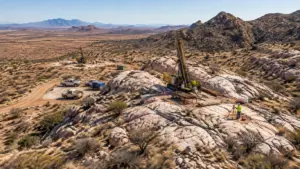
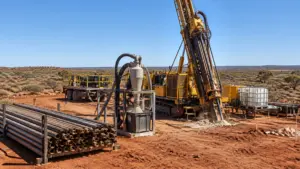
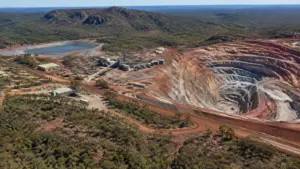
Gold mining operation and processing infrastructure in a West African setting.

Gold is trading around $4,376 an ounce on COMEX, up about 0.10% in the latest session, according to the market snapshot referenced for this analysis and CME Group futures data. The move is modest after a powerful run, but the price level is reshaping mining economics well beyond the trading screen.
In West Africa, the central question is no longer whether higher gold prices can lift margins. It is whether Ghana, Côte d’Ivoire and their mining partners can convert those margins into new ounces while managing royalties, permits, security, power and community pressure.
The region’s supply reset is uneven. Ghana remains the production anchor, but Côte d’Ivoire is expanding more quickly through new mines and a broad project pipeline. At the same time, higher government take, restrictions on informal mining and infrastructure constraints could determine how much of the projected growth actually reaches the market.
Gold mining news 2026: the market snapshot
The World Gold Council’s Q2 2026 Gold Demand Trends report describes a market supported by investment demand, central-bank purchases and geopolitical uncertainty. It also warns that mine production is likely to respond only gradually because of operational constraints and long project lead times.
| Indicator | Late-September 2026 reference | Why it matters |
|---|---|---|
| COMEX gold | About $4,376/oz | Supports margins and improves the economics of development projects |
| Latest session move | +0.10% | Shows consolidation after a strong advance rather than a decisive reversal |
| Ghana 2025 production | About 187.3 tonnes | Keeps Ghana as West Africa’s largest producer |
| Côte d’Ivoire 2025 industrial output | About 59.33 tonnes | Establishes a rapidly growing second-tier regional producer |
| Ghana 2026 production outlook | 6.1–6.7 million ounces | Growth depends on large-scale mine performance, ASM formalization and fiscal stability |
| Côte d’Ivoire 2026 outlook | About 62 tonnes | Further growth is expected before larger projects ramp up |
| Ghana gold royalty range | 5%–12% | The upper end applies at very high gold prices under the new sliding-scale regime |
Sources: World Gold Council; Ghana Chamber of Mines; Ghana government reporting cited by Reuters; Côte d’Ivoire government data cited by Mining.com and Ecofin; CME Group market data.

Ghana’s production record meets a tougher fiscal regime
Ghana produced approximately 5.94 million ounces of gold in 2025, a sharp increase from about 4.82 million ounces in 2024, according to the Ghana Chamber of Mines. Reuters and Ghanaian industry sources have placed the 2025 total close to 6 million ounces, equivalent to roughly 186–187 tonnes.
The composition of that growth is important. The Chamber reported that artisanal and small-scale mining output rose to about 3.11 million ounces in 2025, while large-scale production was approximately 2.83 million ounces. That means informal and small-scale operations accounted for more than half of reported national production.

For 2026, the Chamber’s outlook places total output in a range of 6.1 million to 6.7 million ounces. Newmont’s Ahafo North, Shandong Gold’s Namdini, Asante Gold’s Bibiani and AngloGold Ashanti’s Obuasi are among the operations expected to support the large-scale component.
The risk is that fiscal reform could delay expansions or change project sequencing. Ghana’s Minerals and Mining (Royalties) Regulations, 2025, which took effect in March 2026, replaced the previous flat gold royalty with a sliding scale. Reuters reported that the rate can rise from about 5% at lower gold prices to 12% when gold exceeds $4,500 an ounce.
At approximately $4,376, the market is close to the upper pricing band that matters for Ghanaian producers. That improves state revenue but reduces the portion of each additional dollar of gold price that remains with operators. Ghana also reduced its Growth and Sustainability Levy on gold miners from 3% to 1%, partly to offset the higher royalty burden, according to KPMG and Ghanaian government reporting.
The effect on existing production may be limited in the short term. The more important question is whether the new regime changes investment decisions for expansions and marginal projects. The Ghana Chamber of Mines has warned that uncertainty around the framework could put the 2026 target at risk.

Gold processing infrastructure illustrates the capital and energy demands behind new production.
Côte d’Ivoire is building a new growth platform
Côte d’Ivoire’s industrial gold output reached approximately 59.33 tonnes in 2025, according to government data cited by Ecofin. Authorities expect output of about 62 tonnes in 2026, with further growth anticipated as new projects move from construction into production.
The country’s expansion is being driven by several operating mines. Fortuna Mining’s Séguéla is guiding for 160,000 to 180,000 ounces in 2026, while Perseus Mining’s Yaouré remains a major contributor. Endeavour Mining’s Lafigué has also added new capacity to the national system.
The largest potential step-change is Montage Gold’s Koné project, which is expected to produce more than 300,000 ounces a year once fully ramped up. Government and industry sources have linked first production to 2027. Resolute Mining’s Doropo project is another important development, with projected annual output of roughly 169,000 ounces and higher production during its initial years.
Turaco Gold’s Afema project shows how the next generation of ounces is being developed. A project profile published by Mining Weekly describes a planned conventional open-pit operation with:
- A mineral resource of 4.65 million ounces;
- A probable reserve of approximately 1.912 million ounces;
- Planned average production of about 196,000 ounces a year;
- A six-million-tonne-per-year processing facility;
- A projected capital cost of approximately $410 million; and
- First production targeted for 2029, subject to completion of the definitive feasibility study and permitting.
The project is designed to connect to Côte d’Ivoire’s national electricity grid, with water infrastructure, roads and tailings facilities included in the development plan. That detail underscores a key difference between a resource and a producing mine: new ounces require power, water, transport, approvals and social consent before they generate revenue.
Permits, royalties and security will shape the supply response
Côte d’Ivoire has remained comparatively open to exploration. Reuters has reported the granting of new mining permits, while the government has expanded exploration licensing as it seeks to challenge Ghana’s regional dominance over the longer term.
However, permitting is becoming more selective. In September, Côte d’Ivoire’s National Security Council announced a six-month moratorium on new semi-industrial and artisanal gold permits, according to Ecofin reporting. Industrial mining was not included in the freeze, but the decision reflects the government’s effort to separate regulated mine development from illegal gold panning.
Authorities have also pledged stronger action against illegal mining, including river patrols, drone surveillance and site closures. The policy has two objectives: reduce environmental damage and bring more gold into formal channels where it can be taxed and monitored.
Royalty terms remain another consideration. The Afema project profile notes Côte d’Ivoire’s 10% noncontributing state interest under the mining code and a royalty structure that can reach 6% of gold sales at major projects. That is lower than Ghana’s upper sliding-scale rate, although project economics still depend on taxes, ownership structures, power costs and capital intensity.
Security risks are not uniform across West Africa. Côte d’Ivoire benefits from relative political stability compared with several Sahel neighbors, but illegal mining, land disputes and community expectations remain operational issues. In Ghana, conflict between artisanal miners and industrial operators can affect access, security spending and the pace of mine development.
Central banks and ETFs keep the correction risk in focus
The supply story is unfolding against a market where demand is strong but not uniform.
The World Gold Council expects central banks to remain significant buyers in 2026, supported by reserve diversification, inflation protection and geopolitical risk management. Official-sector demand is less sensitive to short-term price changes than ETF or futures positioning, giving the market a structural source of support.
ETF demand is more exposed to real rates. The World Gold Council said Western ETF flows could remain sensitive to monetary policy expectations, the U.S. dollar and the 10-year TIPS yield, which was approaching 2.5% in its Q2 outlook.
That creates a clear correction risk. If real rates rise further, ETF outflows accelerate and the dollar strengthens, gold could retreat even while central banks continue buying. The result would likely be a sharper difference between the structural demand outlook and the short-term trading path.
For miners, a correction toward the low $4,000s would still leave prices well above historical planning assumptions. But high prices do not remove cost inflation, permitting delays, power interruptions or construction risk.
Gold price scenarios for 2026–2027
The following framework is based on the World Gold Council’s demand outlook, the current COMEX reference point and the range of institutional forecasts cited in recent market reporting. It is not an investment recommendation or a price target.
| Scenario | 2026 range | 2027 range | Main conditions |
|---|---|---|---|
| Bear | $4,000–$4,400/oz | $3,600–$4,200/oz | Higher real rates, stronger dollar, sustained ETF outflows and reduced geopolitical risk |
| Base | $4,300–$4,900/oz | $4,400–$5,100/oz | Continued central-bank buying, stable-to-elevated real rates and gradual investment demand |
| Bull | $5,000–$5,400/oz | $5,200–$6,000/oz | Falling real rates, weaker dollar, renewed ETF inflows, fiscal stress or a major geopolitical shock |
Under the base case, Ghana and Côte d’Ivoire would have a strong revenue environment but would still face execution constraints. Under the bull case, more marginal deposits could attract financing, while governments would have greater incentive to raise their share of mining rents. Under the bear case, projects with high capital costs or weak infrastructure would be more vulnerable to delays.
The regional reset is about conversion, not discovery
West Africa already has substantial gold resources. The strategic reset is about converting those resources into reliable, formal and politically sustainable production.
Ghana must balance higher public revenue with the need to keep large-scale investment moving. Côte d’Ivoire must maintain its permitting advantage while controlling illegal mining and building the power, water and transport systems required by new mines.
At $4,376 an ounce, the price signal is powerful. But the next phase of gold mining news will be decided less by the headline price than by how efficiently operators and governments turn that signal into permitted projects, stable operations and new ounces.
For additional context, see Skillings’ Gold Price Forecast 2026: Fed Hike Tests the $4,300 Floor and the Gold category.
LinkedIn snippet
Gold is holding near $4,376 an ounce after a strong run, but West Africa’s supply response will depend on more than price. Our analysis examines Ghana’s new 5%–12% royalty regime, Côte d’Ivoire’s 2026 production pipeline, power and security constraints, central-bank demand, ETF risk and 2026–2027 gold price scenarios.
X snippet
Gold near $4,376/oz is reshaping West Africa’s mining pipeline. Ghana faces higher sliding-scale royalties while Côte d’Ivoire advances Koné, Afema and Doropo. Analysis covers central banks, ETFs, real rates, security, power and bear/base/bull price scenarios through 2027.